- Neighborhood
- NRG Park
- Year built
- 1965
- Style
- Mid-Century Modern
- Era
- Mid-Century
- Architect
- Hermon Lloyd & W. B. Morgan; Wilson, Morris, Crain & Anderson
- Designations
- National Register of Historic Places (#13001099, listed January 15, 2014) · State Antiquities Landmark (designated January 27, 2017)
Significance
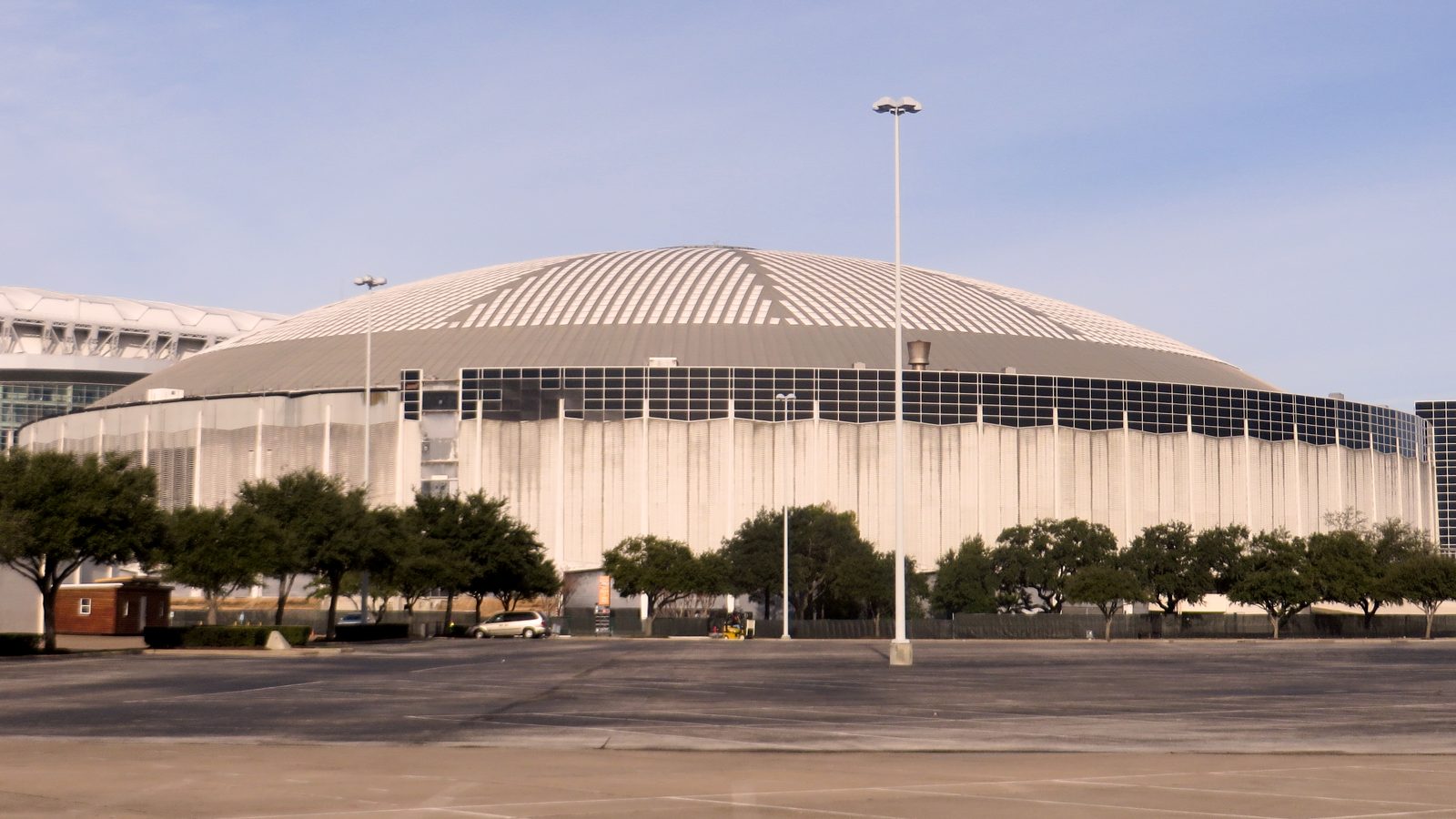
Opened on April 9, 1965 as the Harris County Domed Stadium, the Astrodome was the world's first multipurpose domed sports stadium and was quickly nicknamed the "Eighth Wonder of the World." Championed by Roy Hofheinz, it was designed by Hermon Lloyd & W. B. Morgan with Wilson, Morris, Crain & Anderson, with structural engineering by Walter P Moore. When its natural grass died under the skylit roof, it became the first major venue to install artificial turf in 1966, the surface that became known as AstroTurf, and it introduced the first animated scoreboard. The dome was home to the Houston Astros from 1965 to 1999 and the Houston Oilers from 1968 to 1996, hosted the Houston Livestock Show and Rodeo from 1966 to 2002, and in 2005 sheltered thousands of New Orleans residents displaced by Hurricane Katrina. Closed as noncompliant with fire code in 2008, it was listed on the National Register in 2014 and designated a State Antiquities Landmark in 2017, which means it may not be removed or altered without a permit from the Texas Historical Commission.
Climate risks tracked
Click a risk to see what it means for this building.
The Astrodome's greatest resilience asset and liability is the same thing: a vast clear-span steel lattice roof. Hurricane winds load the dome's large surface and its perimeter connections, so any reuse plan has to verify fasteners, roof membrane and the skylight panels against current wind standards. The surrounding NRG Park is a sea of paved parking on flat clay soils, and heavy rain events like Harvey have shown how quickly that pavement sheds water toward the building's lower concourses. Because the stadium has sat largely unused since 2008, the long term threats are heat and moisture inside an unconditioned enclosed volume, which accelerate corrosion of steel and deterioration of interior finishes. Proposals to raise the floor for below grade parking or to convert the grounds to shaded green space would reduce flood exposure and heat, but as a State Antiquities Landmark, changes to the dome's profile or structure require Texas Historical Commission permits.
Use the preservation assistant to talk through retrofit strategies for these specific threats.
Location
Preservation Assistant
Grounded in Astrodome
Suggested questions
Or ask your own question about Astrodome below. I can cover its history, architecture, and climate-resilient retrofits.