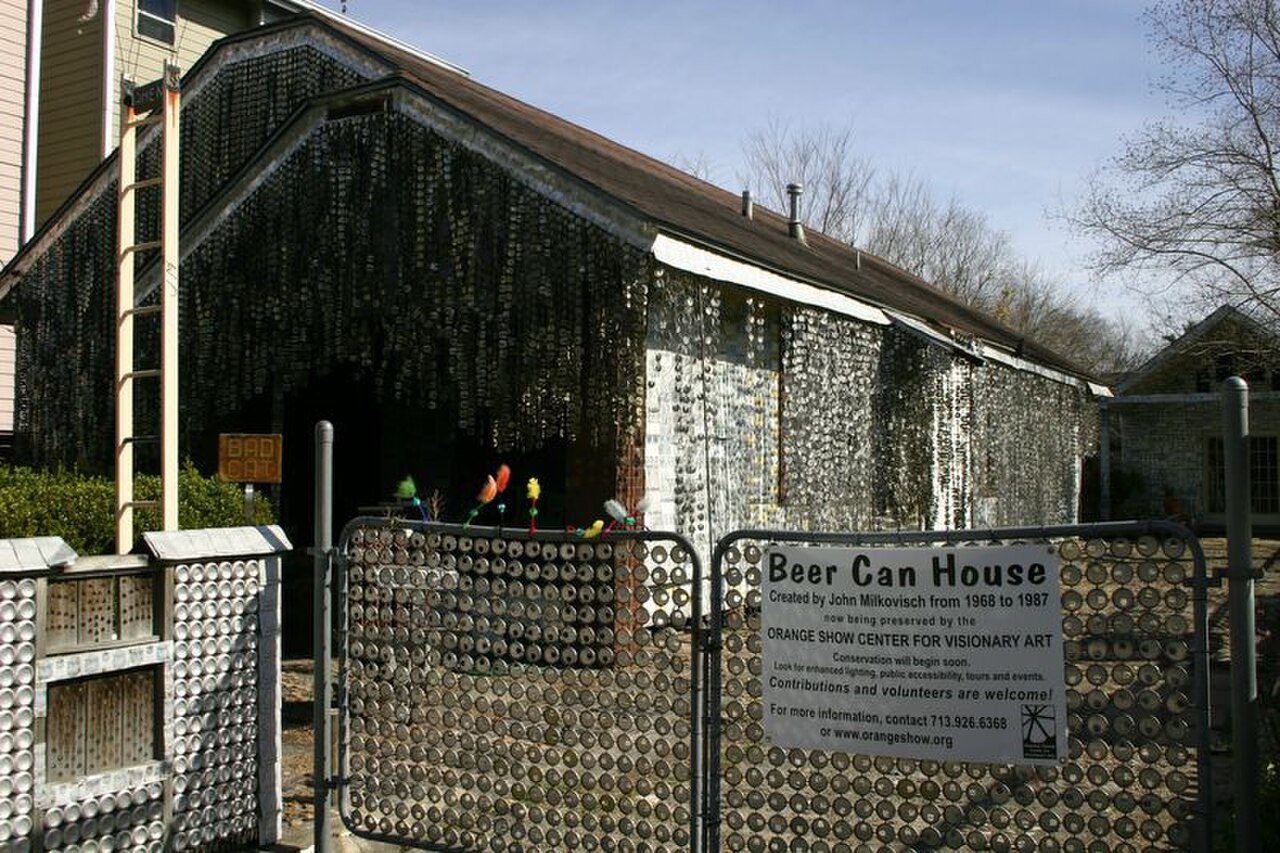
- Neighborhood
- Rice Military
- Year built
- 1968
- Style
- Folk / Vernacular assemblage
- Era
- Mid-Century
- Architect
- John Milkovisch (folk artist)
- Designations
- Preserved by the Orange Show Center for Visionary Art
Significance
Beginning in 1968 and continuing for roughly eighteen years, upholsterer John Milkovisch transformed his ordinary Houston bungalow into an extraordinary work of folk art by cladding its exterior in tens of thousands of flattened aluminum beer cans, along with garlands made from can pull tabs and marbles embedded in the yard and driveway. Milkovisch, who worked at the Southern Pacific Railroad, undertook the project initially as a practical solution to avoid repainting and yard mowing, but it grew into an obsessive and celebrated example of vernacular assemblage art. After his death, the Orange Show Center for Visionary Art acquired and restored the house, ensuring its survival as one of the defining examples of Houston's rich tradition of self-taught, visionary folk architecture, alongside sites like the Orange Show itself.
Climate risks tracked
The Beer Can House's aluminum can cladding, while resistant to rust, is a lightweight material that can be torn loose or dented by hurricane force winds, requiring careful reattachment and maintenance after major storms. Its modest wood frame bungalow structure beneath the cans sits on a standard residential lot vulnerable to urban flooding during intense rain events like Hurricane Harvey, which can saturate the original wood siding and framing underneath the metal cladding. Houston's extreme summer heat also causes significant thermal expansion and contraction in the metal cans and their aluminum fasteners, gradually loosening the decorative assemblage over time and requiring ongoing conservation.
Use the preservation assistant to talk through retrofit strategies for these specific threats.
Location
Preservation Assistant
Grounded in Beer Can House