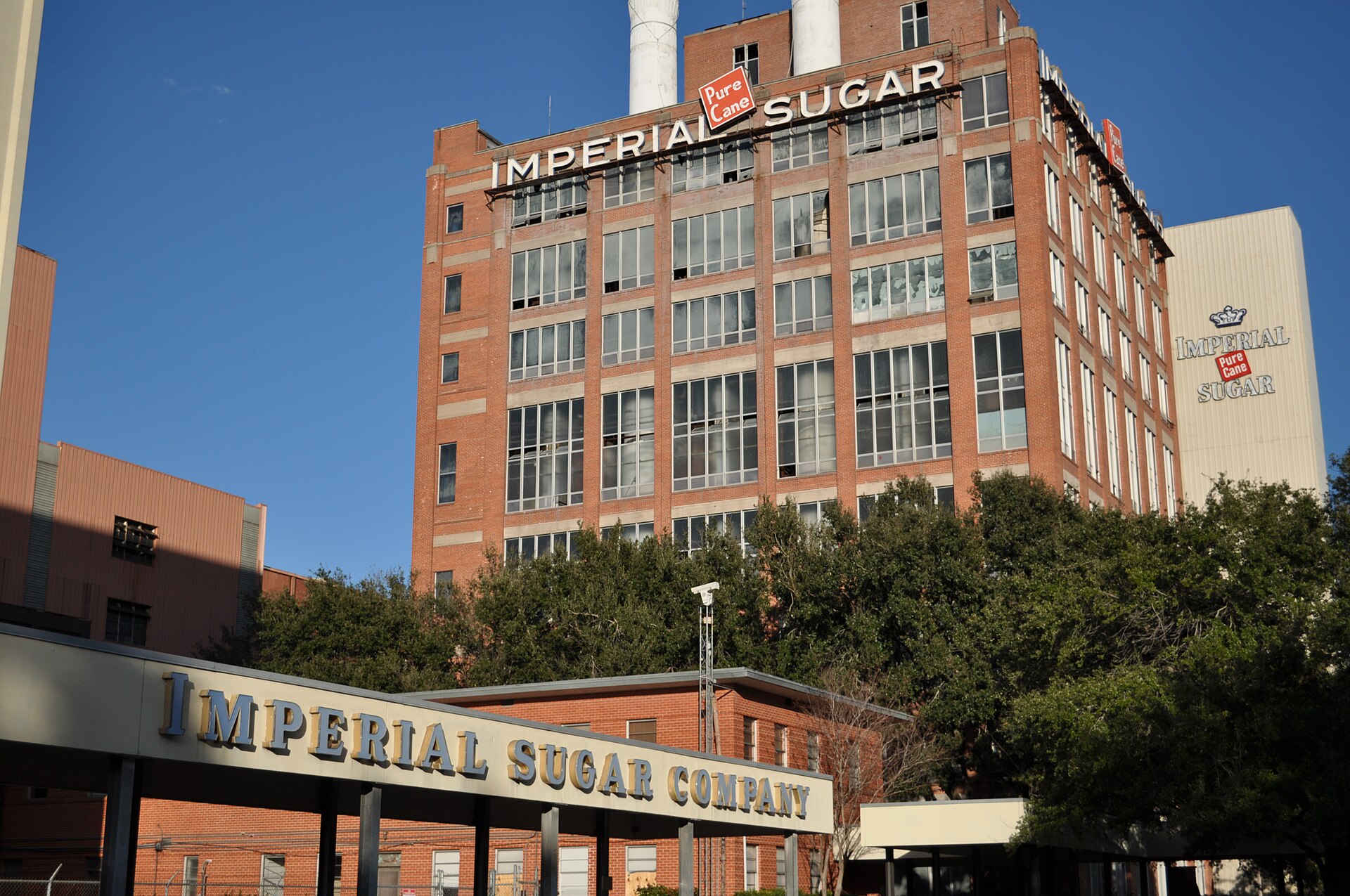
Imperial Sugar Char House
US Highway 90A between Main St and Ulrich St, Sugar Land, TX
- NRHP
- Neighborhood
- Sugar Land
- Year built
- 1925
- Style
- Industrial
- Era
- Interwar
- Designations
- Imperial Historic District, National Register of Historic Places (district designated 2017)
Significance
The Char House was built in 1925 by the Imperial Sugar Company, whose refinery anchored the company town of Sugar Land. Owners I. H. Kempner and W. T. Eldridge authorized the eight story steel and brick structure, front and center on Highway 90A, to raise refined sugar production by fifty percent in the face of new competition. Construction cost about $1,000,000, and the building remained the tallest in Fort Bend County until the 1970s. Inside, thirty vertical cast iron tanks, each larger than a railroad tank car, were filled with bone char. Amber sugar syrup poured in at the top filtered through the char, which absorbed impurities and left the syrup clear before it was pumped on to be crystallized into white sugar. The building's height forced the company to raise a new water tower 50 feet taller for fire protection, and the pair became the landmarks travelers saw first when approaching from Houston or Richmond. The refinery closed in May 2003 and the Char House sat vacant through a series of stalled redevelopment plans. The surrounding Imperial Historic District was designated by the State of Texas and the U.S. Department of the Interior in 2017. In June 2025 the City of Sugar Land acquired the district, including the Char House, and preservation planning is now underway with construction anticipated to begin in fall 2026.
Climate risks tracked
Click a risk to see what it means for this building.
The Char House stands near Oyster Creek, which flooded parts of Sugar Land during Hurricane Harvey in 2017, so any reuse plan needs ground floor flood protection, raised mechanical and electrical systems, and backflow prevention. The building has stood vacant since 2003, which means two decades of water intrusion risk through failed windows and roof openings. The eight story red brick facade and its grid of large industrial windows face hurricane winds across open land along Highway 90A, so window stabilization and anchoring of the rooftop Imperial Sugar sign structure matter. Long vacancy in Houston area humidity invites mold and corrosion of the steel frame and the surviving cast iron filter tanks, so drying the building out, repointing mortar, and controlling interior moisture are the first resilience steps before any adaptive reuse.
Use the preservation assistant to talk through retrofit strategies for these specific threats.
Location
Preservation Assistant
Grounded in Imperial Sugar Char House
Suggested questions
Or ask your own question about Imperial Sugar Char House below. I can cover its history, architecture, and climate-resilient retrofits.