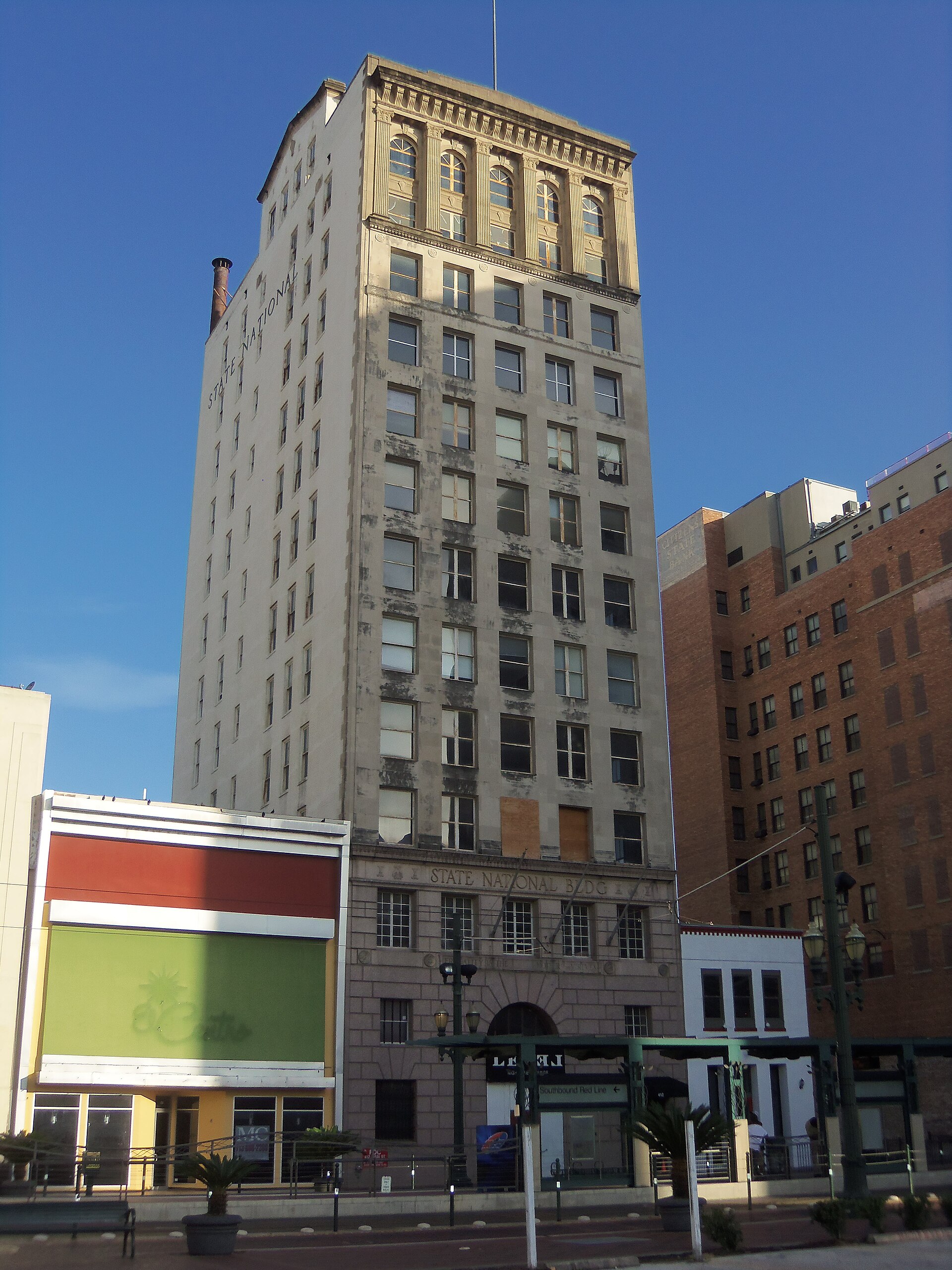
- Neighborhood
- Downtown
- Year built
- 1923
- Style
- Neoclassical / Beaux-Arts
- Era
- Interwar
- Architect
- Alfred C. Finn
- Designations
- National Register of Historic Places (listed August 11, 1982)
Significance
State National Bank grew from the State Bank and Trust Company, which opened in 1915 and took a national charter after joining the Federal Reserve. In 1922 it began this ten story skyscraper designed by Alfred C. Finn, the self trained architect who went on to shape much of Houston's skyline. It was completed in 1923 at a cost of about $500,000, with the motto "Frugality is the mother of all virtues" carved into its base. The bank left in 1946, and new owners replaced the rough granite base with polished Indiana limestone in 1948. After decades of neglect, the building was restored in the early 1980s and listed on the National Register in 1982 as one of the few surviving Neoclassical skyscrapers in Houston. It reopened in December 2023 as a Moxy hotel.
Climate risks tracked
Click a risk to see what it means for this building.
This part of Main Street lies close to Buffalo Bayou and the Market Square area, one of downtown's most flood prone zones. The original basement held the bank's vaults and boiler room, so for a hotel today the essentials are keeping critical systems out of the basement, installing backflow protection, and planning barriers for the grand arched entrance. The Beaux-Arts cornice and ornament on the upper facade face the strongest hurricane winds and should be inspected and anchored on a regular schedule. Double hung windows can be protected with interior storm units. Limestone and brick absorb moisture in Houston's humidity, so maintaining roof drainage and sound mortar keeps water from damaging the structure.
Use the preservation assistant to talk through retrofit strategies for these specific threats.
Location
Nearby landmarks
Preservation Assistant
Grounded in State National Bank Building
Suggested questions
Or ask your own question about State National Bank Building below. I can cover its history, architecture, and climate-resilient retrofits.