- Neighborhood
- Museum District
- Year built
- 1964
- Style
- Modernist fountain
- Era
- Mid-Century
- Architect
- Eugene Werlin
- Designations
- City of Houston Protected Landmark (designated June 29, 2016)
Significance
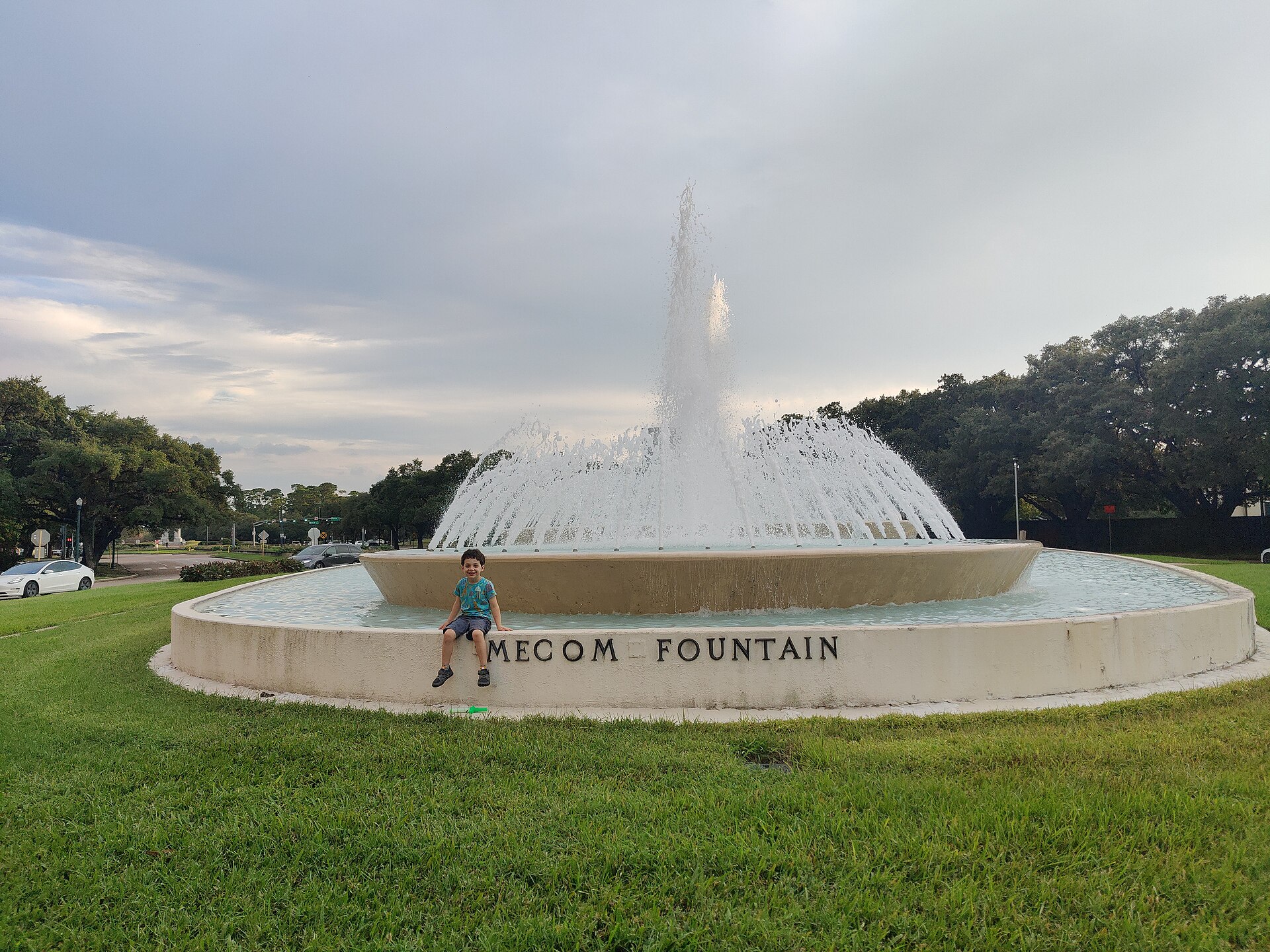
Mecom Fountain marks the entrance to Hermann Park at the traffic circle where Main Street meets Montrose Boulevard. In September 1963 oil businessman John W. Mecom Sr. and his wife, Mary Elizabeth, gave the fountain to the City of Houston. Mecom had bought the Warwick Hotel across the street in 1962. Designed by architect Eugene Werlin, the fountain was installed in 1964 on the site of George Kessler's old sunken garden, keeping the oval shape of the earlier landscaped median. The fountain has three raised concrete bowls, each with a central jet, set inside a low oval pool wall. It was the largest fountain in Houston when it was built, and its clean design makes it a statement of modernist civic art. Werlin also designed the 1968 Miller Outdoor Theatre elsewhere in Hermann Park.
Climate risks tracked
Click a risk to see what it means for this building.
Fountains face particular stress from Houston's climate. Evaporation increases during heat waves, and droughts can bring water restrictions, so efficient recirculating pumps and water treatment help the fountain keep running responsibly. Hard freezes like the February 2021 storm can crack pipes and concrete, so draining or protecting the plumbing before freezes is essential. The raised concrete bowls are exposed to constant wetting and drying, which can crack concrete and corrode steel reinforcement. Regular concrete repair with matching materials, waterproof coatings, and care of the lighting system protect its modernist form. Settlement in Houston's clay soil can affect the pool, so monitoring for leaks and cracks is important.
Use the preservation assistant to talk through retrofit strategies for these specific threats.
Location
Nearby landmarks
Preservation Assistant
Grounded in Mecom Fountain
Suggested questions
Or ask your own question about Mecom Fountain below. I can cover its history, architecture, and climate-resilient retrofits.