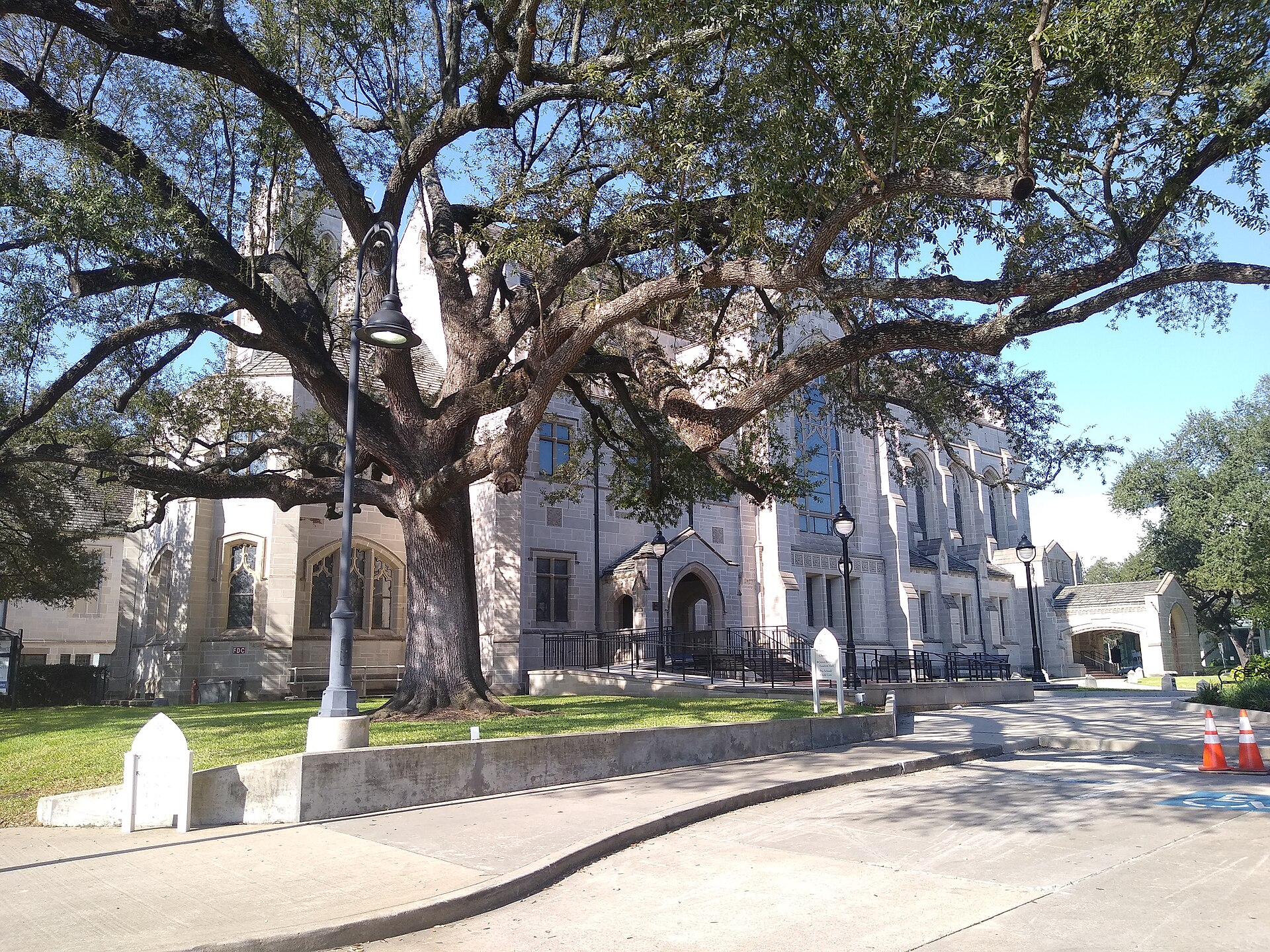
St. Paul's United Methodist Church
5501 Main St, Houston, TX
- Recorded Texas Historic Landmark
- Neighborhood
- Museum District
- Year built
- 1930
- Style
- Gothic Revival
- Era
- Interwar
- Architect
- Alfred C. Finn
- Designations
- Recorded Texas Historic Landmark
Significance
St. Paul's United Methodist Church on Main Street was completed in 1930 to designs by Houston architect Alfred C. Finn, one of the city's most important early 20th century architects, whose works include the Gulf Building and the San Jacinto Monument. The congregation, founded in 1906, built the Gothic Revival church as Houston grew rapidly southward along Main Street. The church is built of stone with a prominent tower, pointed arch windows and traceried openings characteristic of the Gothic Revival style favored for American churches of the period. It anchors the northern end of the Museum District and remains an active congregation. The building is a Recorded Texas Historic Landmark.
Climate risks tracked
Click a risk to see what it means for this building.
The church's stone tower, pinnacles and slate or tile roof present large surfaces to hurricane winds; loose masonry units and failing mortar joints at height are the main risk and should be repointed with compatible lime based mortar. Stained glass windows need protective glazing or well fitted storm panels that do not trap moisture against the historic glass. Brays Bayou, which flooded the Museum District severely during Tax Day floods and Hurricane Harvey, lies nearby, so ground floor mechanical systems and storage should be elevated or protected. Houston's humidity encourages biological growth on the stone, requiring gentle cleaning and good site drainage.
Use the preservation assistant to talk through retrofit strategies for these specific threats.
Location
Nearby landmarks
Preservation Assistant
Grounded in St. Paul's United Methodist Church
Suggested questions
Or ask your own question about St. Paul's United Methodist Church below. I can cover its history, architecture, and climate-resilient retrofits.